
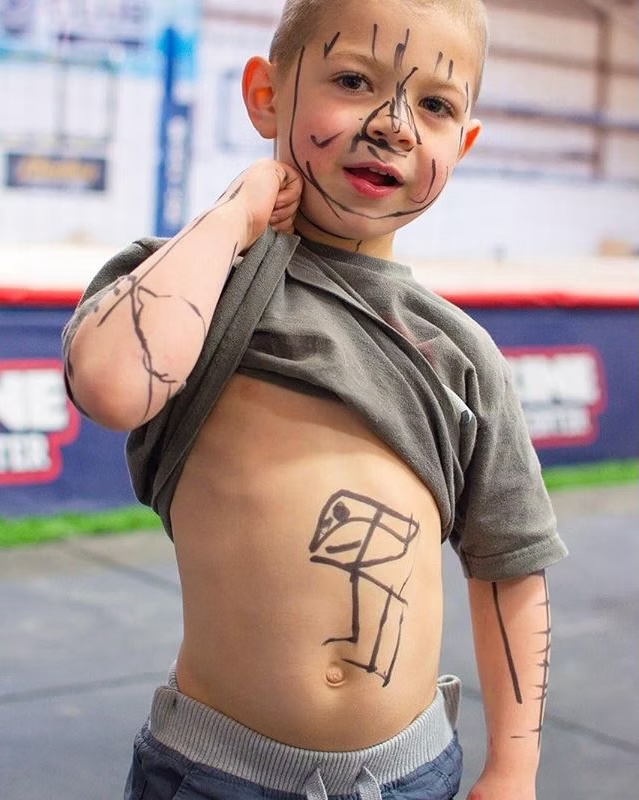
As soon as the markers are out he’s got a mustache, a pirate patch, circles on his palms, a smiley face on his belly, and a dragon down his arm. Every time. Why?! Sitting at home it wasn’t a big deal but just before heading off to school or meeting my parents for lunch, c’mon man! On the way to the car there goes the tattooed man, happy as could be and proud of his new eyebrows.
This was a common occurrence in our house on a daily basis. My youngest son would decorate himself in the finest of scribbles when we had the markers out, when we didn’t have the markers out, when we told him not to, when we gave him extra paper, when he was alone at night in his room supposedly sleeping. Sensory is always on my mind but when it comes to my own kids I often miss the signs. It wasn’t until we were at a lake one day and I watched my son zenning out in the sand, totally quiet and in his own world, burying his legs, rolling around, and building small castles of sand on his own hands. He was totally at peace. This is the kid I had to get a trampoline for the living room because he out-bounced the ottoman. Tigger. My kid is Tigger. And here was Tigger not bouncing, not running around, not slapping me or hitting the dog. He was just chillin. And that’s when it hit me. He’s a tactile seeker! Of course! He is drawing on himself because it is calming and organizing. All the pieces fell into place. He always has his shoes and shirt off, he is always in the dirt, he even rubbed maple syrup on his face a few times. There it was staring at me in my un-markered face!
Seekers are people that seek sensory input. They seek it because it makes them feel good. It helps calm their nervous system and organize their thoughts. Proprioception seekers jump, hit, smash, crash, bounce, and smoosh their way through their day. Vestibular seekers gravitate to swings, fast rides, and intense movements. As opposed to avoiders who do the opposite. My son is drawing on himself because he is seeking tactile input. This is what his body needs to “ground” himself, to feel comfortable, to cope. So what can I do about this? Well, I can get him a new box of sparkle markers and have him walk down Venice beach showing off his fresh tats or I can help him get that input in a functional way. So we developed a sensory diet for him.
A sensory diet is getting someone sensory input though out the day in a functional way so they don’t seek it in a dysfunctional way. Or avoid it too I guess. For his tactile seeking I try to expose his skin to as much of the environment as I can. When it’s appropriate shoes are off. This is at home, at the park, in the car, or even walking through the woods. The soles of the feet provide a lot of important input anyway (but that is a whole other topic). I am intentional about letting him play with putty, slime, water beads, kinetic sand, beans, as many different tactile things I come across before school, after school, and every so often on the weekends. Often when sitting in his little art desk I use the Lakikid seat cushion with those little spikey things for him to put his feet on. As this came to light it made me realize how when just a year ago he often was not found without something in his hand. This could have been because he was “protecting” the palms of his hands which are extremely sensitive. Because I labeled him a seeker does not mean he is always seeking tactile input. It really means that sensory system is wired a little differently. So perhaps where he was looking for input in one part of his body, he was avoiding it in another. This was another piece of the puzzle. So weight bearing activities like crawling and climbing where there is pressure to his palms can help integrate that sensory system a little more. So along with tactile play I make sure he his hanging from a trapeze or pulling ropes, climbing trees, crawling, just engaging the whole world with his hands (By the way, holding a screen makes this very difficult. Just sayin).
Since being intentional about his sensory diet, it has been a few months since we’ve had any Adam Levine arms or Mike Tyson faces. The occasional fresh tat comes from the rub on ones we get at the gas station with every fill up (plus a free cup of coffee! Quite the bargain, I say). We see less frequent melt downs and when they do come they don’t last as long. He is more at peace and even though most objects in his path ricochet him like a pin ball he is happier, more comfortable in his own body. (We’ll talk about vestibular and proprioception next time I have a cup of coffee at 6 pm and can’t sleep). The tactile system is a powerful system and often goes under my radar. But It’s one of the big three and if kids don’t get a certain amount of tactile input when they are younger it can be quite difficult to navigate life. Let kids put the spoon down and scoop the mashed potatoes with their hands, play in the mud, paint with their feet, strip down to undies, roll in the grass, pick up the bugs, smash trees with sticks, and let them cover themselves in shaving cream. I’d pass on the face in the syrup though – that’s just nasty.
